

In a mere 101 days, the 2026-27 men’s college basketball season is going to tip off at 9:30 a.m. ET with Notre Dame and Villanova hooping in … Rome!? Breakfast basketball in the Eternal City.
Andiamo. That’s ‘let’s go’ in Italian.
Which means it’s time for a grab-bag of lists to help digest an offseason that doesn’t seem to end and look ahead to what’s next.
Let’s dive in.
National storylines
1. The 2027 NCAA Tournament will feature 76 teams
I really only have two thoughts on the expansion ordeal:
- I hate it.
- I will watch the games.
2. Michigan‘s second act, this time without Dusty May (and Yax)
Hail to the victors, who now have to replace their head coach, their best player, their second-best player, their third-best player, four more rotation cogs and multiple assistant coaches.
Got all that?
Dusty May’s meteoric rise from Florida Atlantic to the NBA’s Dallas Mavericks in less than three years is not normal, but even making history comes at a price. In an unusual twist, Michigan will now have to defend a championship without the mastermind.
A head coach winning a title and immediately dipping does not happen in college basketball. You have to go back to Larry Brown in 1988, who directed Kansas to a title before accepting the San Antonio Spurs gig. The following season, KU finished under .500 in the Big 8 and didn’t even make the NCAA Tournament under a fella named Roy Williams.
This Michigan outfit is far more equipped to stay very competitive, but it’s going to take a yeoman’s effort from everybody. Top assistant Mike Boynton was handed a two-year deal (it’s closer to a one-year deal when you look in between the lines), and Michigan was able to retain everyone but injured sixth man LJ Cason, who transferred to Miami. With a core of point guard Elliot Cadeau, sophomore breakout candidate Trey McKenney, five-star guard Brandon McCoy, Tennessee transfer forward JP Estrella and Cincinnati transfer big man Moustapha Thiam, the Wolverines have more than enough talent to be a Big Ten contender yet again.
But there’s going to be more than a few nights when May will be missed. Oh, and Yaxel Lendeborg, Morez Johnson and Aday Mara.
3. UNC enters the Michael Malone era
North Carolina couldn’t woo Dusty May or Tommy Lloyd, so it pivoted to former NBA Finals champion Michael Malone. Is this a stopgap or a real-deal solution for one of the most prestigious basketball programs in the land?
To his credit, Malone has dove headfirst into what it takes to be a high-major basketball coach. He’s attacked the challenges of recruiting overseas and domestically without an issue. But Malone’s first roster is a bit underwhelming on paper. Without bigs, it’s hard to hold serve against the elite teams in this supersized era of college basketball. That could be UNC’s Achilles heel. Greece product Alex Samodurov is a good addition, but there’s growing consternation surrounding the status of 7-footer Sayon Keita, who has still not made it to Chapel Hill.
Malone should be an upgrade on the X’s and O’s and strategy front, but this roster doesn’t scream ACC contender at the moment. Caleb Wilson, you are missed.
4. The SEC’s stranglehold on basketball is primed to return
The SEC looks like it could be fantastic in 2026-27 like it was in 2024-25. You could make a strong argument for 11 of the SEC’s 16 rosters to be a Top 25-caliber team. We’ll get surprises — good and bad –, but I’d be shocked if the SEC is not regarded as the top league in America next March. Florida is big, bad Florida again. Texas has had an elite offseason. Alabama retained two of its best three players. Arkansas loaded up on five-star talent in typical John Calipari fashion. Kentucky has a chance after landing prized Iowa State transfer Milan Momcilovic. Vanderbilt retained All-American point guard Tyler Tanner. Tennessee went on a major portal spending spree. Missouri landed a useful portal class and a five-star lead guard. Texas A&M made waves in roster-building this spring. LSU could have a EuroLeague team in the SEC. Georgia retained four starters from a tournament team. Auburn is going to be better.
You get the gist.
Money is at the epicenter of a football-obsessed league making sure hoops is a priority as well. Even the poorest SEC teams have close to $8 million to build a roster, while the richest sniff $20+ million. That ain’t chump change, and it shows up on the rosters.
The SEC retained 10 of its top-30 scorers from a year ago, and it poached 11 top-30 scorers from the four other high-major leagues. The SEC has far and away the most proven contributors of any high-major league entering 2026-27.
Strap up.
5. The Mountain West massacre
There was something pure about the Mountain West. 11 teams in the same neck of the woods who wanted nothing more than to bludgeon the other. A couple of seasons ago, 24 of the 99 Mountain West games either went to overtime or were decided by four points or fewer. Just pure, raw, unfiltered mayhem with late-game drama amid raucous environments. But the main tradition usually included something like Colorado State getting worked on the road by Wyoming before turning around and pummeling the same Wyoming club when they laced it up again in Fort Collins a couple weeks later.
It was magnificent.
Anyways, it’s all gone. The scourge that is realignment has struck again.
Boise State, Colorado State, Fresno State, San Diego State and Utah State are off to a new-look Pac-12. Hawaii, UC Davis and UTEP will backfill the league, but this won’t hit the same.
Take me back to the days of killer UNLV lefty Bryce Hamilton lacing it up twice a week trying to unleash one of his patented heaters, even though everyone in the league knew he was trying to get to his pull-up.
The new-look Pac-12 and Mountain West
Burning questions
6. Who is allowed to play?
It’s July 23, and there are still some serious questions about who will be eligible to play next winter. It was the talk of the town at Peach Jam with no answers in sight. Part of this fiasco is on the NCAA, which could have implemented the 5-in-5 eligibility model at a more feasible time in the calendar.
The uncertainty is looming over the sport like a dark cloud.
It’s a potential liferaft for teams like Gonzaga, Texas Tech and LSU, who have openings on the depth chart after missing on top targets earlier in the cycle.
It’s a source of serious frustration for rival staffs who assembled rosters under the pretense that these seniors were not going to be allowed to play, per the NCAA.
It changes Cincinnati’s outlook if MJ Collins can hoop. Xavier is a much better basketball team with Filip Borovicanin on the team. Minnesota has a real chance to make the NCAA Tournament if Cade Tyson is suddenly allowed to play after hooping in Summer League with the Golden State Warriors. Some real needle-moving free agents could become available … in August.
This is all so backwards.
Some finality is needed ASAP.
7. Bill Self’s last dance?
The Kansas Hall of Famer has had multiple alarming health scares, including missing a game against Colorado last season because he was hospitalized with AFib, which is an irregular heartbeat. Self contemplated retirement this spring before choosing to return to the sidelines to give it a go.
Self, now 63, has not made it to the second weekend since Kansas won the National Championship in 2022. Is he pining for another run? And can this Kansas team actually scale that mountain? KU is going to be in the spotlight all season because this could very well be it for Self, who is one of the best offensive coaches in the history of the sport.
8. Jon Scheyer’s worst moments have clouded his dominance. Is this the year it all goes away?
Scheyer has won 42 of his last 44 games against ACC competition, and yet, the two most memorable games of his career have featured some stunning last-second collapses. One against Houston in the 2025 Final Four (ban loose ball fouls that result in free throws forever) and then last year’s meltdown in the Elite Eight against UConn.
Scheyer has been meme’d, dubbed a choke artist and watched as his late-game offense got put under the microscope.
All of it is understandable and also remarkably dismissive of one of the game’s best coaches.
It won’t go away until you win. Scheyer, to his credit, has gotten back up off the mat and built another elite Duke roster. But the reality is that he could go undefeated in the ACC this year and none of it would matter for more than a few.
Scheyer will always have this perception until he wins a National Championship. Can he scale the mountain and dispel the claims once and for all?
Way-too-early ACC basketball tiers: Duke, Louisville at top of 2026-27 outlook as intriguing contenders emerge
Isaac Trotter
9. When is the rent due for Pat Kelsey?
Louisville has poured so much money into roster-building lately. An injury to Mikel Brown Jr. understandably kept Louisville from reaching its full potential last year. No bother. There’s money a-flowin’ in Bourbon City. Louisville, once again, was one of the top spenders in the portal. Louisville paid up for Kansas’ Flory Bidunga and Oregon‘s Jackson Shelstad. It won a bidding war for Iowa transfer forward Alvaro Folgueiras. This roster looks to be in the $20 million range.
It’s time to win. Simple as that.
The days of spending top dollar and getting 30-pieced by Duke just have to be over.
10. Will Mark Pope turn the temperature down in Lexington?
Kentucky is 29-26 against high-major teams under Pope. That’s not the standard at Kentucky, even though the injury luck has been brutal with Jaland Lowe, Jayden Quaintance, Jaxson Robinson and Lamont Butler.
The 2026-27 season is an inflection point for Pope because winning cures everything, and this roster looks more suited to his style of play. Kentucky has shooting out the wazoo with Milan Momcilovic, Kam Williams and Alex Wilkins. Kentucky has a legit next-level big man in Malachi Moreno, who could be a two-way enforcer. It has real point guard depth in Zoom Diallo and Wilkins after having little creativity last year once Lowe went down with a season-ending shoulder injury.
Even though the SEC is going to be a bear, Pope can’t afford to be just solid. Kentucky has to be good. It needs to compete for the SEC regular-season title deep into February. It needs to quit losing games at Rupp to Georgia. It needs to give itself a chance to make real noise in the Big Dance.
It’s time.
Milan Momcilovic commits to Kentucky: Mark Pope salvages his offseason by landing last big transfer available
Matt Norlander
First impressions from the notable new coaches
There are over 50 new Division I coaches. Here’s the top takeaway from the notable early tenures.
11. Jerrod Calhoun, Cincinnati: Calhoun has stockpiled a ton of coveted portal sleepers, headlined by Utah State’s Adlan Elamin, Boston College‘s Jayden Hastings, Akron‘s Eric Mahaffey, Utah State’s Elijah Perryman and North Dakota State‘s Trevian Carson.
12. Michael Malone, UNC: Malone has prioritized skill over athleticism so far in roster-building. I think that’s going to be a tenet for UNC moving forward.
13. Luke Murray, Boston College: Money Williams-to-Boston College got the attention from numerous rival coaches and GMs.
14. Randy Bennett, Arizona State: Arizona State’s roster looks a lot like how Saint Mary’s w was constructed. A sharp pick-and-roll guard (this year, it’s Portland transfer Joel Foxwell) surrounded by a ton of size. Arizona State has four gigantic centers, and it’ll have a ton of length on the perimeter when Emmanuel Innocenti (6-5), Dillan Shaw (6-7) and Paulius Murauskas (6-8) are at the 2, 3 and 4, respectively.
15. Justin Joyner, Oregon State: Joyner has an impeccable reputation, and his initial roster is very impressive for the new-look Pac-12. The Beavers retained Josiah Lake (13.1 points, 38% from 3-point range) and surrounded him with a ton of real-deal transfers. Joyner’s initial roster-building strategy is shot-making guards complemented by wings who can shoot and a cavalry of rim-running bigs.
16. Bryan Hodgson, Providence: New Friars point guard Malik Mack and athletic wing Miles Byrd had, objectively, poor offensive seasons a year ago. Mack shot 38% from the field. That ain’t it. Byrd wasn’t much better at 40%. And yet, Hodgson still wanted them. There’s clearly some self-belief here that his read-and-react offense can unleash a new and improved version of portal targets.
17. Gerry McNamara, Syracuse: Positional size is McNamara’s initial calling card. 10 of the top-11 players on the roster are 6-5 or taller.
18. Casey Alexander, Kansas State: It was notable that none of the players from Belmont‘s 26-win team followed Alexander to Kansas State. The money in the market went up, and K-State’s coffers weren’t quite as voluminous.
19. Alan Huss, Creighton: There wasn’t a ton of projection with the top guys in this Creighton portal class. You know Wes Enis is going to shoot the cover off the rock. You know Oswin Erhunmwunse can be one of the top shot-blockers. You know BJ Davis is a veteran guard who can play on or off the ball. Creighton needed more known commodities. That should help the role allocation process coalesce much more smoothly.
20. Will Wade, LSU: Wade’s roster-building antics are jostling the status quo, but it’s hard to shake the feeling that if Saliou Niang, Brice Dessert and Michael Ruzic are all healthy, the Tigers’ front-line will be one of the better units in the SEC.
All-American prophecies
This is my ballot. I’ll debate with my CBS Sports colleagues about their selections in a few months!
FIRST TEAM
21. PG Tyler Tanner, Vanderbilt
22. PG Jeremy Fears Jr., Michigan State
23. PG Rob Wright, BYU
24. F Tommy Haugh, Florida
25. F Flory Bidunga, Louisville
SECOND TEAM
26. PG Braylon Mullins, UConn
27. G Trey McKenney, Michigan
28. SF Tyran Stokes, Kansas
29. F Thijs de Ridder, Virginia
30. C Motiejus Krivas, Arizona
THIRD TEAM
31. G Silas Demary Jr., UConn
32. SF Amari Allen, Alabama
33. SF Pryce Sandfort, Nebraska
34. F David Mirkovic, Illinois
35. F Braden Huff, Gonzaga
*Texas Tech’s JT Toppin would be an easy All-American choice, but the timeline on his return from a torn ACL is murky*
Who will be the most impactful transfers?
Over 2,700 players entered the transfer portal this past spring to cash in on the most lucrative cycle the sport has ever seen. Here are our predictions about which 10 will be the most impactful, factoring in fit, talent and projected usage with his new club.
36. F Flory Bidunga
Transferring from: Kansas | To: Louisville
The scout: Bidunga is a pogo-stick leaper who hammered down 82 dunks (second-most in this portal) and is an elite defensive prospect. The 6-foot-9 forward is switchable, mobile and highly disruptive on the perimeter and in the paint defensively. Louisville wisely paid up for Bidunga, who can reward that investment by making a serious run at ACC Defensive Player of the Year.
37. F Milan Momcilovic
Transferring from: Iowa State | To: Kentucky
The scout: Momcilovic is the best shooter in all of college basketball. No one made more triples than Momcilovic (136), and the 6-foot-8, 225-pound forward makes tough shots look remarkably easy. Momcilovic’s fadeaway midrange jumper is almost impossible to deflect, and it serves as a needed counter to his barrage of off-movement triples that he can uncork even if a defender is draped nearby. The shot-making is so pure that it covers up some of Momcilovic’s warts (no offensive rebounding, little creation, no rim pressure and average defense). He is the exact type of player who should thrive in Mark Pope’s offense.
Way-too-early SEC basketball tiers: Florida and Texas headline college basketball’s best league
Isaac Trotter
38. G John Blackwell
Transferring from: Wisconsin | To: Duke
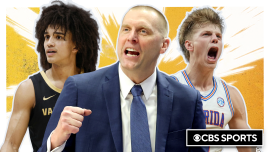
The scout: Blackwell is a powerful scoring guard who plays a physical brand of clean basketball. Blackwell is just so skilled, smart, competitive and tough. Blackwell has become a knockdown shooter from downtown, and he sheds defenders with get-off-me drives. He has All-ACC upside at Duke.
39. SF Tounde Yessoufou
Transferring from: Baylor | To: St. John’s
The scout: Yessoufou’s reps were resolute on staying in the 2026 NBA Draft, but the feedback from the league was eye-opening, so they made the last-second decision to exit and pick St. John’s.The consensus around the country is that this is going to work really, really well. Yessoufou has some skill deficiencies that he needs to iron out, specifically with his handle and also his jumper. Rick Pitino’s player development is unquestioned (see: three NBA Draft picks last month). But Yessoufou plays ridiculously hard and has the tools to be a hellacious defender. That is exactly what Pitino craves. St. John’s also has a potential stretch 5 in the mix in Ruben Prey, who should keep the paint free for Yessoufou to deck it and pressure the rim religiously. This is going to work.
40. C Massamba Diop
Transferring from: Arizona State | To: Gonzaga
The scout: The 7-foot-1 center had an impressive rookie season in the Big 12, using his length, fluidity and burgeoning skill to transform into one of the best big men in the league. Diop runs the floor so smoothly and owns a terrific catch radius around the basket. Playing with an unselfish, set-the-table point guard like Moe Odom certainly helped, but Diop has an advanced skill set that’s not far from blossoming. He can hit face-up jumpers or the occasional pick-and-pop trey. He can put the ball on the deck for drives. He can protect the rim or guard in space. He can be a weapon on the glass and as a lob threat. Once the game slows down, Diop can be a terror. There’s All-League potential in 2026-27 if it clicks with room for so much more.
41. G PJ Haggerty
Transferring from: Kansas State | To: Texas A&M
The scout: Haggerty’s game is no secret. The well-traveled combo guard can score the rock. Haggerty is an outstanding transition scorer who can get to the charity stripe at will, and he’s improved his decision-making and 3-point shooting along the way. He’s cracked double figures in 94 of the last 96 games over the past three seasons. Haggerty will be the favorite to lead the country in scoring next season at Texas A&M if he gets to play 33+ minutes.
42. SF Juke Harris
Transferring from: Wake Forest | To: Tennessee
The scout: Harris was one of the top wings in the portal. The 6-foot-7, 200-pound junior can operate as a dangerous off-movement shooter who showed his feel for the game as a cutter, slasher, rebounder and secondary creator. Harris can play in pick-and-rolls, but he’s most dangerous off the ball. Tennessee has been so good in the portal in recent years. Harris is up next.
43. F David Punch
Transferring from: TCU | To: Texas
The scout: Punch is one of the top two-way players in the country. The 6-foot-7, 245-pound bruiser forward is arguably the most switchable player in this portal class. He can root out centers, battle power forwards, switch onto slippery guards and everything in between. Punch adds plenty of secondary rim protection, rugged rebounding and real utility offensively because he’s a willing passer, sharp cutter and a physical mismatch threat. Punch only made 11 triples last year, but he impacts winning whether the jumper is going in or not.
44. F Paulius Murauskas
Transferring from: St. Mary’s | To: Arizona State
The scout: Murauskas is a yoked forward who combines outstanding positional size with an inside-out game. The 6-foot-8, 235-pound forward uses backdowns to obliterate smaller defenders, and he can do a little bit of everything as a passer, handler and spot-up shooter. Murauskas is more of a 4-man who can play on the wing than vice versa, but he defends multiple positions and impacts the game positively in an abundance of ways. Following coach Randy Bennett to Arizona State was a shrewd move.
45. G Stefan Vaaks
Transferring from: Providence | To: Illinois
The scout: The 6-foot-7 lead guard has limitless range and can navigate ball screens with craft and uncoachable feel. The defense may never be even adequate, but Vaaks’ combination of size, shooting and playmaking is so tantalizing. Vaaks’ value ticks up because he can be an impact player on or off the ball. Vaaks fits like a glove in an Illinois scheme that is so guard-friendly. There’s NBA potential here if his shot selection and feel for the game improve.
Best (projected) offenses
46. Illinois: Even without the brilliant Keaton Wagler, Illinois has the personnel to be a blowtorch offensively. The Illini’s offensive spacing is immaculate. No team gets more 3s from its frontcourt. That opens up the paint for a guy like Andrej Stojakovic to put a ton of pressure on the rim. Illinois has multiple candidates to mismatch hunt and create advantages. Sophomore forward David Mirkovic is going to have a massive season as a pass-dribble-shoot 4-man who has trimmed down his body. Big man Tomi Ivisic could lead all centers in 3s this season. Stojakovic projects to be one of the top isolation scorers. Providence transfer Stefan Vaaks is a jumbo lead guard who can drain parking-lot treys and whip dots. Illinois will have some excellent cutters on the floor in Jake Davis and five-star freshman Quentin Coleman, too. All this shooting and skill paired with an identity that demands offensive rebounding is one dangerous combination.
Way-too-early Big Ten basketball tiers: Michigan, Illinois, Michigan State primed to shine in 2026-27
Isaac Trotter

47. Alabama: Nate Oats is the best offensive coach in the country. The spacing is immaculate, every player understands what the plan is on every possession and the decision-making is sharp. An elite transition offense is Oats’ bread and butter, but Alabama has quietly been one of the SEC’s best three halfcourt offenses in six consecutive seasons.
I think No. 7 is on the way.
Alabama won’t suppress turnovers quite as well as a season ago without Labaron Philon, who rarely turned it over despite a heavy workload, but a backcourt pairing of senior guard Aden Holloway and potential lottery pick Amari Allen is so potent. Alabama should be a bit better on the offensive glass this year thanks to some offseason reinforcements. Kentucky transfer Brandon Garrison, Boise State transfer Drew Fielder and Mississippi State transfer Jamarion Davis-Fleming all rated in the 64th percentile or higher in offensive-rebound rate last season. That’s a sticky stat in portal scouting.
More offensive rebounds paired with impeccable shot selection under this head coach is the recipe for Alabama to be excellent offensively yet again.
48. Florida: Leverage. That’s Florida’s secret sauce offensively. The Gators should be able to find mismatches regularly in the halfcourt since Alex Condon and Rueben Chinyelu have turned into efficient one-on-one scorers. The Gators should continue to smash in transition with Tommy Haugh and Boogie Fland pressing the gas in the open floor. Florida also rarely takes ill-advised shots without offensive rebounders in position. This group is a lock to be an elite offensive rebounding team with Condon, Haugh and Chinyelu on the floor together.
If Florida’s guards can just not miss approximately every single jump shot for a month, the Gators are in sterling shape to be an elite offense. The Gators are just too big to fail.
49. BYU: Returning point guard Rob Wright is a magician in pick-and-rolls, and BYU has built this entire offense with him in mind. There’s a ton of shooting on this roster, headlined by Collin Chandler (41% from 3-point range on 4.9 attempts), Tyler Betsey (41% from 3 on 4.0 attempts) and five-star freshman Bruce Branch III (39% from 3-point range on 5.0 attempts on the 3SSB circuit). BYU also landed veteran Polish big man Jakub Urbaniak, who should be an asset in the screen-and-dive game.
The talent is here and the coaching is top-notch. Kevin Young has constructed back-to-back top-12 offenses in his first two seasons at BYU. Young eliminates the clutter in his offenses, and there are few wasted possessions. If Wright stays upright all year, BYU’s offense is going to be a headache to defend.
50. Duke: Jon Scheyer has built his offenses around a generational 4-man like Cooper Flagg or Cameron Boozer in each of the past two seasons. It got another one in the pipeline in prized freshman big man Joaquim Boumtje-Boumtje. While Boumtje-Boumtje is a tantalizing prospect who will show major flashes, building an offense around a 17-year-old is unlikely.
There’s a good chance that Wisconsin transfer lead guard John Blackwell is the fulcrum of this offense. How does Jon Scheyer shape-shift it? It’s hard not to trust this staff to press the right buttons offensively. Duke uses non-shooters as spacers in excellent ways to clear driving lanes, and the quartet of Blackwell, Cayden Boozer, Caleb Foster and five-star freshman Deron Rippey Jr. gives Scheyer four guards who can boogie to the rim at will.
Duke has multiple bigs who can pass, multiple shooters, plenty of athleticism and the deepest point guard room in the land. If high-upside youngsters like Boumtje-Boumjte or Cameron Williams pop, Duke will be a shoo-in to finish in the top-10 offensively for the fourth-straight season.
51. Texas A&M: This is a bullish projection for Texas A&M’s offense, but Bucky McMillan is one of the rising stars in coaching and the talent on this roster is clear as day. The well-traveled PJ Haggerty should cook in this up-tempo Aggies’ scheme that prioritizes rim pressure and transition buckets. That matches up with Haggerty’s strengths. I have high expectations for G-League product Bryson Warren, who shot over 39% from 3-point range on 11 attempts playing against pros. The 6-foot-3, 22-year-old shooting guard could be a real threat to bang 100 triples this season. If Mackenzie Mgbako can get back to full speed, that’s a dangerous big wing/stretch 4 who can go get you 18 points on any given night.
Texas A&M’s supporting cast is also deep. McMillan has two speedy point guards, bigs who don’t have overlapping skillsets and real wing depth. Getting Zach Clemence back for another year is a sneaky-nice addition as well. Add another 40% 3-point shooter to the mix.

52. Virginia: UVa’s entire starting lineup can shoot. That opens up space to invert the floor, find mismatches and create high-quality shots. Forward Thijs de Ridder will be in the mix for ACC Player of the Year, and both Sam Lewis and Chance Mallory are expected to have serious usage-rate bumps. Mallory’s speed will be a nice changeup paired next to de Ridder’s bruising, physical style.
UVa’s portal class won’t get any “best haul” Instagram posts, but Ryan Odom landed numerous useful veterans who will impact winning. UC Irvine transfer Jurian Dixon and Arkansas State transfer Christian Harmon could both sniff 40% from 3-point range playing secondary roles alongside the head honchos.
Shooting + speed + more shooting + offensive rebounding + a little more shooting = Top 10 offense.

53. Texas: Get ready for smashmouth hoops on the 40 Acres. The frontcourt pairing of David Punch and Matas Vokietaitis should help Texas gobble up second-chance opportunities, and the Longhorns’ combination of size, length and athleticism should be overwhelming at all times. I expect the free throw line to be the best friend for this Texas offense. New point guard Isaiah Johnson rated in the 94th percentile in free throw rate last season, per CBB Analytics. Vokietaitis checked in at the 98th percentile, drawing over 8.3 fouls per 40 minutes with his physicality and relentlessness. Punch drew a ton of fouls. Auburn transfer wing Elyjah Freeman drew a bunch of fouls. It won’t be pretty, but it will be effective, and Texas has NBA-caliber talent in Marcus Spears and Austin Goosby, who can serve as ceiling-raisers for this offense.
54. Michigan State: This should be the best Michigan State offense in years. Point guard Jeremy Fears Jr. is a basketball savant. His feel for the game is off the charts, and he’s got a ton of offensive talent at his disposal. Coen Carr is back to dunk everything, and fellow returners like Jordan Scott and Kur Teng should take strides forward as secondary options. But it’s the newcomers that make this extra exciting. Freshmen like Jasiah Jervis and Carlos Medlock Jr. are legit bucket-getters, and a healthy Kaleb Glenn is a big deal for Michigan State to add another shot-maker and cutter to the wing mix. As usual, MSU will crash the glass like madmen. As usual, MSU will run the floor in transition unlike any other. But there’s much more juice here offensively in the backcourt. I trust Fears to create good shots trip after trip.
55. Gonzaga: I know what the point guard situation looks like after losing Mario Saint-Supery to the EuroLeague. I know that Jack Kayil isn’t on the team.
But I can’t quit what this offense could be if Braden Huff and Massamba Diop are taking turns just absolutely shredding teams in the paint. Mark Few and Stephen Gentry are excellent offensive coaches, and this frontcourt could be unstoppable. Gonzaga needs some good fortune with its point guard pursuit, but I just can’t quit this offense. Its sets are too crisp, and these bigs should run the floor like freight trains. If Gonzaga somehow got Donovan Dent on campus and eligible, he’s averaging 13 assists.
Amy Kontras / USA TODAY Sports
Best (projected) defenses

56. Iowa State: The Cyclones have answers to the test defensively at all three levels of the floor. Big man Blake Buchanan is mobile, stout and strong. Killyan Toure and Bradley transfer Jaquan Johnson are both excellent point-of-attack defenders. Northern Iowa transfer Leon Bond III and Northwestern transfer Tre Singleton are also huge wings/forwards who can cover ground. T.J. Otzelberger’s crew should have no issues getting stops.

57. Arizona: Opponents shot just 47% at the rim when Mo Krivas was on the floor. The 7-2 center is a Big 12 Defensive Player of the Year frontrunner. So is Ivan Kharchenkov. The 6-7 wing is rugged, tough and craves a scrap. Arizona should be so big on the perimeter when Derek Dixon and Caleb Holt are on the floor together, too. But this projection is about Krivas and Kharchenkov being game-wreckers.
58. Houston: The mere presence of JoJo Tugler makes Houston’s defense formidable. The 6-8 big man wreaks havoc on the perimeter with his traps, and he can sprint 25 feet back to contest at the rim. His court coverage is absurd.
59. Florida: Todd Golden has orchestrated back-to-back top-10 defenses. With this personnel, Florida will be right in the mix for the best defense in the land. Center Rueben Chinyelu is an enforcer, and point guard Boogie Fland is quietly an elite defender in his own right. Florida is just so big. Elite rim protection paired with excellent defensive rebounding is the recipe to be outstanding on that end of the floor. Florida has it.
60. Duke: Scheyer has a ton of competitive guys who really care about getting stops. Boozer and Foster are both reliable lead guard stoppers. Dame Sarr is one of the best wing defenders in the country. Big man Patrick Ngongba has high feel on the defensive end of the floor and can sniff out actions before they happen. Belmont transfer Drew Scharnowski will help out on that end with his physicality, rebounding and athleticism. That core is more than enough to build a solid foundation. It’s going to be hard to generate easy shots against Duke’s size and length, especially when Sarr, Foster, Boozer and Ngongba are on the floor together.
61. Miami: Jai Lucas’ frontcourt is going to be so physical. 6-11 center Somto Cyril is enormous and can play multiple coverages defensively. Prized freshman forward Caleb Gaskins is an engaged, willing defender, armed with a college-ready frame. Shelton Henderson and Dante Allen should be helpful defenders, too. Miami is going to give teams some black eyes this season.

62. Villanova: Kevin Willard should have a fortress of rim protection whenever 7-4 center Luigi Suigo and 6-9 forward KJ Evans Jr. are on the floor together. Villanova rated 347th in block percentage a year ago. It could be the Big East’s best shot-blocking team in 2026-27. That’s how quickly things can change in free agency. The arrow is pointing up for this Villanova defense.
Way-too-early Big East basketball tiers: St. John’s and UConn primed to jostle for supremacy, again
Isaac Trotter

63. UConn: Silas Demary Jr. is a ferocious defender. Jayden Ross‘ athleticism will be a big asset for this UConn defense. Nik Khamenia and Braylon Mullins both compete. Oh, and new big man Najai Hines is going to be an absolute monster. His hand-eye coordination is outstanding. UConn needs its young guys to get up to speed in a hurry, but the Demary-Ross-Hines trio gives Danny Hurley three difference-making defenders at three levels.
64. Louisville: The way rival point guards talk about Flory Bidunga’s defense is just … different. The 6-9 big man can guard all five positions, and he has the speed, length and anticipation to keep up with even the speediest lead guards. Pat Kelsey has never had a top-20 defense, let alone a top-10 unit, but he’s never had a Bidunga, either. Louisville has enough positional size and lineup versatility to trot out some huge lineups if it wants. Defense has to be at the core of this team. It can’t happen without a dialed-in Karter Knox, though. He can make a ton of money if he becomes one of the elite defenders in the ACC.

65. Iowa: Ben McCollum’s defenses are usually in the right place at the right time, which leads to a bunch of takeaways. Now, he has high-major size with 7-3 big man Andrew McKeever entering to control the paint and the glass. With a horde of returners getting a full offseason in the McCollum scheme, the number of scouting report mistakes should tick down even more. Plus, Iowa will actually be able to rebound at a much higher level when Cam Manyawu plays the 4 next to McKeever. McCollum could have lineups with four guys who are 6-7 or taller on the floor together. If Iowa’s rebounding is better and it continues to take the ball away like McCollum defenses always do, this unit could sniff top-10 status.
2027 NBA Draft Top 10 projection
66. SF Tyran Stokes, Kansas: Pass-dribble-shoot forwards don’t grow on trees and the best version of Stokes is inevitable.
67. SG Caleb Holt, Arizona: Holt is tough, smart and dependable. He should be a high-level, two-way player for Arizona.
68. PG Jordan Smith Jr., Arkansas: Smith has all the intangibles and should be a total pest defensively for John Calipari.
69. PG Stefan Joksimovic, Spain: Joksimovic just moves differently. The 6-7 point guard is not expected to pursue the college route, but the tape is tantalizing.
70. SG Bruce Branch, BYU: Branch’s foundation of size and shooting is something everyone in the NBA craves, and I trust the developmental model set at BYU.
71. SG Braylon Mullins, UConn: Elite shooter who has a terrific motor. It’s all about the physical development to round out the rough edges of Mullins’ game. He’ll be awesome in Year 2 in Storrs.
72. F Thomas Haugh, Florida: Haugh’s motor is his superpower. I’m curious how much more refined his skill-set has become with another full offseason.
73. PG Jason Crowe Jr., Missouri: Crowe can put the ball in the bucket every single day of the week and twice on Sundays.
74. F Cameron Williams, Duke: Williams is a bit of a polarizing prospect, but I want to bet on the Duke incubator lab of player development.
75. F Anthony Thompson, Ohio State: Thompson is one of the best shooters in the entire class at 6-foot-8. Size and shooting get you paid.
Teams I’ll be higher on than consensus

76. Indiana: Darian DeVries was clearly sick and tired of being undersized and out-talented, so Indiana went into the portal and did something about it. The Hoosiers are primed to trot out a double-big lineup of 6-foot-10 Alabama transfer Aiden Sherrell and 7-foot-2 SMU transfer Samet Yigitoglu. Your bigs control your floor in the Big Ten, and IU has two good ones. At minimum, Indiana will have one big fella patrolling the paint for all 40 minutes.
But the entire IU calculus comes down to two guys: Markus Burton and Sherrell. If Burton and Sherrell can transform into one of the Big Ten’s best inside-out duos, Indiana can be a major factor because it has a little bit of everything else with this supporting cast. There’s shooting here with Bryce Lindsay, Darren Harris and all three of Indiana’s top-100 freshmen. There’s offensive rebounding and rim deterrence from Yigitoglu, who is a mountain of a man. There’s an athletic wing defender who can slash in Jaeden Mustaf.
All of that is fine, but it doesn’t matter all that much unless Burton and Sherrell are dudes. Burton, while undersized, is a stone-cold killer. DeVries can build this offense around him. Burton is a crafty, paint-touch machine who could get his shot blocked three times in a row and come right back looking to destroy on the next possession. Fearless is an understatement. Sherrell is a key X-Factor, though. He’s shown flashes of being everything you want in a big fella. Sherrell hit 27 treys last year at a 34% clip, and that pick-and-pop game will be vital. He’s helpful on the offensive glass, in the short-roll game and as a rim protector. But can he be tough and repeatedly impose his will? Ultimately, an awesome lead guard, multiple serviceable bigs and numerous role players who can shoot should be more than enough to vault Indiana into the top half of the Big Ten with room to compete for the Big Ten title if everything pops.

77. Oklahoma State: What an offseason for Steve Lutz. This Oklahoma State roster has made an about-face and enters 2026-27 with loads of playable depth after it found usable pieces in every area of roster-building. Oklahoma State retained two key building blocks in point guard Kanye Clary and enormous big man Benjamin Ahmed. It landed two top-35 freshmen in forward Latrell Allmond (beast on the boards) and Anthony Felesi (excellent wing defender). And boy, the Pokes did work in the portal, reeling in some shooting with UNC’s Luka Bogavac and UCF‘s Jordan Burks, some high-major size in Georgetown transfer Julius Halaifonua and Arizona State transfer Andrija Grbovic and a dynamic backup point guard in Sam Houston State‘s Jacob Walker. We didn’t even mention destructive defender Kashie Natt, who needs a waiver to play after spending time at the NAIA ranks, but would be a no-doubt rotation player.
This is a tournament team that could sniff the top-25 with the right breaks.
Way-too-early Big 12 basketball tiers: Arizona, Houston and Kansas headline wide-open league after mass exits
Isaac Trotter

78. St. John’s: Donnie Freeman‘s gut-wrenching season-ending Achilles injury is a blow, but St. John’s should still be a top-20 team. Veteran international point guard Quinn Ellis is going to be a force multiplier, making talented, five-star talent like Tounde Yessoufou and Ian Jackson the best versions of themselves.
79. Auburn: I’m in on an Auburn bounce-back season. This is a tournament team. Auburn has gotten very old, very quickly this offseason. All five transfers are entering their fourth season of college basketball. The international products — sniper Mantas Rubstavicius and big man Narcisse Ngoy — will be 24 and 22, respectively, when the season tips off. Add in the retention of Tahaad Pettiford and Kevin Overton, and Steven Pearl is poised to have a top-eight rotation of upperclassmen at every single spot.
Pettiford is the engine. This is his team now, and the explosive lefty could make a run at leading the SEC in scoring now that Keyshawn Hall is out of the mix. Auburn has a ton of shooting on this roster with Pettiford, Overton, Rubstavicius and South Alabama transfer Adam Olsen. It has also transformed its frontcourt. Ngoy was one of the top international bigs in the past cycle. The 6-foot-11, 245-pounder will be a factor on the glass and as a rim protector. Santa Clara transfer Bukky Oboye adds some freaky tools as a mobile lob threat and shot-blocker. Troy transfer Thomas Dowd is an energizer bunny who strikes all the right tones as an elite connector. Creighton transfer Owen Freeman could be a buy-low candidate as a second-unit bucket-getter who tortures other backup bigs. Very few teams can say they’re bringing a big man who averaged 16 and 7 at a high-major team off the bench. Auburn has that in Freeman.
An awesome lead guard surrounded by a cavalry of bigs and plenty of shooting is a winning recipe.
I expect a more balanced club with less nonsense and no drama on Selection Sunday.
80. West Virginia: Speed. That’s the first thing you notice about this new-look West Virginia roster. Butler transfer Finley Bizjack and top-20 freshman Miles Sadler can both hit the gas and leave defenders in the dust. Sadler has the opportunity and the talent to be a real Big 12 Freshman of the Year contender, and West Virginia is primed to give him the ball and let him shred from Day One.
There’s room for this offense to be a tough cover with Sadler and Bizjack playing on the ball, Joson Sanon adding shot-making, big man Mo Sylla operating as a lob threat and FSU transfer Martin Somerville checking in off the bench to bring instant offense and plenty of triples. Sylla also has terrific defensive tools and could be a match made in heaven under outstanding defensive coach Ross Hodge. West Virginia’s defense won’t allow much at the rim with the no-middle gameplan and Sylla looming on the back line as a shot-blocker.
Javan Buchanan‘s case for a waiver could make or break West Virginia’s chances to truly compete in this league. Buchanan is trying to get another year of eligibility after starting his college tenure at the NAIA ranks. The 6-foot-7, 4-man is the perfect blend piece for this roster who can be a settling two-way connector, but if he can’t play, WVU’s frontcourt picture gets a little shaky and thin behind Sylla.
Teams I’ll be lower on than consensus
81. Michigan: It’s hard to align with some of the top-five prophecies for Michigan because this offense could take a significant step back, and we know this won’t be the best defense in the country again without Aday Mara, Yaxel Lendeborg and Morez Johnson. Michigan’s new-look frontcourt is really talented, but Moustapha Thiam has significant strides to make to reach his full potential as a two-way menace. Specifically, his shot selection is a major work in progress. Michigan’s depth pieces are also extremely young, and it doesn’t have that unquestioned First Team All-American like Yaxel Lendeborg on the roster. I have Michigan closer to 10th nationally than a top-five club without Dusty May.
82. Houston: The Cougars are good, but they are being power-rated as high as No. 4 nationally by Bart Torvik. That’s extremely aggressive for a roster that lost four NBA players in Kingston Flemings, Emanuel Sharp, Milos Uzan and Chris Cenac. Houston has a high floor because new point guard Dedan Thomas Jr. doesn’t turn it over, and the frontcourt duo of Delrecco Gillespie and JoJo Tugler are menaces on the boards, but the ceiling is a bit lower for this group.
83. North Carolina: I’m getting nervous about UNC’s big man situation. 7-footer Sayon Keita is still not on campus as he wades through all the eligibility red tape. I’m in on Matt Able and freshman Maximo Adams, but UNC could have some hairy moments with this frontcourt. I think UNC is more of a top-30ish team than a top-15 unit nationally.

84. Tennessee: Tennessee is a top-10 team for some. I can’t quite get there, even after all the offensive talent that Rick Barnes has added to the mix. Tennessee could have some extremely high-highs, but this many new faces open up some risk in the portfolio. Can Jalen Haralson and Terrence Hill Jr. consistently make others better? Can this frontcourt be up to snuff? Sophomore big man DeWayne Brown II is a massive X-Factor because there could be nights when Loyola-Chicago transfer big man Miles Rubin struggles with the SEC size and physicality. I have Tennessee rated closer to a top-15 unit nationally.

85. UCF: Johnny Dawkins’ roster was much, much better a year ago. This one could be very mercurial, and I get nervous about an offense that pairs a big man who doesn’t shoot 3s (like John Bol) with a point guard who is hesitant to fire from downtown (like Arturo Dean). UCF is currently rated close to a top-40 team for most models. That feels aggressive.
Don’t overlook these mid-majors

86. New Mexico: Eric Olen has compiled one of the best mid-major backcourts. Sophomore guard Jake Hall had a ton of portal poaches after him, but he ran it back after shooting 45% from downtown on serious volume. New Mexico also retained jitterbug point guard Uriah Tenette and did great work in the portal, headlined by the coup of UC San Diego guard Hudson Mayes. Cal transfer Rytis Petraitis is an excellent buy-low option, as well. If New Mexico’s bigs are solid, the Lobos will be in the mix for an at-large bid because these guards can scoot.
87. Grand Canyon: I really like this team. Grand Canyon has frontcourt depth, multiple reliable ball handlers and plenty of athleticism on the wing in USC transfer Amarion Dickerson and bouncy Quinnipiac transfer Jaden Zimmerman. St. John’s March Madness hero Dylan Darling should be one of the Mountain West’s top point guards, and Grand Canyon has legit high-major size up front with 7-1 center Efe Demirel and 6-10 Tulsa transfer Tyler Behrend. This team should go toe-to-toe with anybody it faces this year.

88. VCU: We’ll see how the rotation shakes out, but VCU could be one of the oldest teams in the nation with eight upperclassmen sopping up double-digit minutes. Your bigs control your floor, and VCU has a good one returning in Lazar Djokovic (13.2 points, 5.2 rebounds in 27.7 minutes). Losing stud guard Terrence Hill Jr. to Tennessee will sting, but VCU’s backcourt should still be a major strength with Nyk Lewis and Brandon Jennings. Phil Martelli Jr. also has wings for days to cycle in and out depending on the matchup. This team will have zoom-zoom guards surrounded by a ton of positional size and athleticism. That’s an ideal combination.

89. Saint Louis: The Billikens are not a one-hit wonder. Even without Robbie Avila and the criminally underrated Dion Brown, Josh Schertz has an outfit that can compete for another at-large bid. Trey Green and Ishan Sharma are certified net-shredders. Jumbo lead guard Amari McCottry is a total handful who supplies a ton of rim pressure. Jump with Kellen Thames at your own risk. His per-minute stats are ludicrous, and the rim is still shaking after he posterized Michigan’s mountain, Aday Mara, in the NCAA Tournament. Saint Louis couldn’t land its top big man target in the portal (Duke did what Duke does), but it rebounded nicely with a trio of bodies who do something different. Colorado transfer Alon Michaeli can mismatch hunt and cut, South Carolina transfer Elijah Strong can face up and rain 3s and Marquette transfer Sheek Pearson projects as an instant-impact rim protector. Plus, Schertz is a dude on the clipboard. SLU hasn’t made back-to-back NCAA Tournaments in over a decade. It’s time to change that.
90. UIC: The Flames crushed it in retention this spring, keeping five key rotation staples, including prized sophomore wing Rashund Washington Jr., who would’ve had a substantial market in the portal. UIC also rounded out the roster nicely with Ohio State transfer point guard Gabe Cupps and Furman shot-making wing Asa Thomas, who started his career at Clemson. Rob Ehsan had the Flames on the doorstep of the NCAA Tournament last year, and the nucleus is in place to be in the mix yet again in 2026-27.
Breakout candidates!
You don’t qualify to be a breakout candidate if you averaged more than 10 points last year.
91. Jaylen Petty, UCLA: Petty is a stone-cold bucket. After playing off the ball last season at Texas Tech, Petty is primed to be a major focal point for UCLA’s offense next year. Every single time Petty shoots the ball, you think it’s going in.
92. Tate Sage, Iowa: Sage is a future NBA player. Be a friend, tell a friend. The 6-foot-7 sophomore wing can pass, dribble, shoot, defend and cut. Sage is going to get a bigger slice of the usage at Iowa now that Bennett Stirtz is off to the NBA. He’ll make the most of his opportunity.
93. Darren Harris, Indiana: Harris didn’t get a ton of tick on some loaded Duke teams, but he should have every opportunity to earn a starting gig for Indiana. The 6-foot-5 sharpshooter should fill a key void for a Hoosiers club that needed someone with his specific skillset. It wouldn’t surprise anybody if he sniffs 40% from downtown on serious volume.
94. Matt Able, North Carolina: Able has a chance to be UNC’s best player in 2026-27. Able is a smooth operator who should get more on-ball reps next season after playing a secondary role for a NC State team that had some dysfunctional moments last year. Able has a gorgeous jumper and a lot of untapped potential, so if he ever gets into the flow state, it’s going to be something.
95. Tre Singleton, Iowa State: Singleton is going to be a significant piece of Iowa State’s Joshua Jefferson Replacement Plan. The 6-foot-8 forward has a little skill and a little ruggedness in his portfolio. He defends. He can pass. He can score inside and out. He’ll rebound. There’s a lot to work with here for T.J. Otzelberger. Singleton is in for a big year.
96. Mercy Miller, Houston: Miller waited his turn behind pros, and now he’s primed to take advantage of the opportunity. The 6-foot-4 junior showed flashes of scoring brilliance, and new Houston point guard Dedan Thomas Jr. will create plenty of easy looks for Miller to take advantage. I think he’s an easy double-digit guy in 2026-27.
97. Davis Fogle, Gonzaga: This is a layup. Fogle plays all gas, no breaks at all times. The 6-foot-7 wing has worked hard on refining his jumper this offseason, which will make him an even more challenging cover and a potential NBA Draft pick if it all pops.
98. Ruben Prey, St. John’s: Prey made the wise choice to stay at St. John’s even though he didn’t get a ton of playing time behind Dillon Mitchell, Zuby Ejiofor and Bryce Hopkins a season ago. Patience will be a virtue for the 6-foot-11 big man who showed moments of being a real asset as a pick-and-pop threat and has some playmaking chops in his back pocket.
99. Kohl Rosario, Kansas: Rosario is the definition of a post-hype sleeper. The athletic, chiseled wing has all the physical tools to be an impact 3-and-D asset for this KU team. He’s going to put a few dudes on a poster this year. Mark it down.
100. Jaden Toombs, SMU: With all five of its top scorers exiting, SMU’s offensive pecking order will be up for grabs. Toombs is about to grab the opportunity by the horns. The sophomore big man had some eye-popping moments down the stretch last season. He should team up with new point guard Rowan Brumbaugh to be a force in pick-and-rolls. A 15-and-8 season is firmly in the range of potential outcomes.
Final Four prediction that’s sure to be wrong
101. Duke, Michigan State, Illinois, Florida