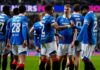


Image credit: © Jim Rassol-Imagn Images
“Appreciate it. Appreciate it out there!”
The 9,901 people that found their way inside loandepot Park last Tuesday were unaware history had been made during the seventh inning. That was when Marlins ace Sandy Alcantara broke Miami’s franchise strikeout record, finally surpassing the immortal Ricky Nolasco with whiff #1,002. Sandy’s manager Andy McCullough as well as his teammates were incredulous when the scoreboard did not acknowledge the accomplishment and, therefore, the “crowd” didn’t much react to the punchout. Eventually, the Marlins scoreboard revealed the milestone, leading to appropriate cheers.

Marlins color analyst Tommy Hutton didn’t care for the delay. “See, the problem I have most of the fans here tonight should know that without having to look at the scoreboard,” he said on the air. “It wasn’t put up on the scoreboard right away, which it should have been. And a lot of fans who came here should have known it anyway. Little things like that irritate me.”
This got us to thinking: has the accomplishment of breaking a franchise’s strikeout record been a big deal in the previous 29 instances?
Well, sometimes it wasn’t even mentioned in the newspapers because the franchise itself was shiny and new. Tom Seaver holds the all-time Mets record for strikeouts—he set the record on July 19, 1968, surpassing Al Jackson’s K total. It was only the eighth year of the Mets’ existence though, so it wasn’t news. A more recent and ridiculous example was when Randy Johnson broke the Diamondbacks’ record. He did it on May 8, 1999, five weeks into his Arizona career. Fun fact: he surpassed Andy Benes, who also held, then lost, the San Diego Padres’ strikeout leader designation eight years later to Jake Peavy.
By then it was 2007, and Peavy got a blurb in the paper. Even though the game was played at Petco Park, the Padres’ home yard, there wasn’t a single mention of the game being momentarily stopped or of Peavy getting any sort of acknowledgment from the crowd or the videoboard.
That’s another thing: for whatever reason most of the documented instances of a franchise strikeout record being broken have occurred on the road, where it’s never going to be celebrated. On July 20, 1990, Roger Clemens passed the one and only Cy Young for most whiffs converted as a member of the Boston Red Sox when he fanned Bill Pecota. This got mentioned on a cheeky video recap of that day’s doubleheader in Kansas City, and in a paragraph that revealed both Clemens’ accomplishment and the fact that George Brett passed Lou Gehrig for 15th all-time in doubles. But there was no stopping of the contest, nor, as far as I can tell, was there some sort of ceremony when the Red Sox returned to Fenway Park.
Andy Pettitte broke Whitey Ford’s strikeout mark as a Yankee on July 1, 2013 in Minnesota. It was acknowledged by the media—not at Target Field. Why would they? (It didn’t help that there was some controversy over whether Ford punched out 1,956 victims or 1,957—either way, Pettitte surpassed both of those numbers.)
On April 23, 2016, “King” Felix Hernandez broke the Mariners strikeout record, passing Randy Johnson (of course). He struck out Rafael Ortega in the 1st inning on a 2-2 changeup. While the powers that be had Felix roll the ball into the dugout for safekeeping, and the Mariners announcers acknowledged the moment, the game was played in Anaheim, so [shrug emoji].
July 3, 1987 was the day Nolan Ryan broke the Astros’ record (13 years after he became the Angels’ strikeout champion). The Associated Press focused more on the fact that Ryan had lost his fourth consecutive game, and his record was now a putrid 4-9. (His ERA wasn’t mentioned.) The game was played in Philadelphia.
Stephen Strasburg set the Nationals/Expos K record on August 9, 2019. But that was at Citi Field in an eventual 7-6 walk-off loss. Strasburg seemed chill about the whole thing when he was asked about passing Steve Rogers’ mark after the game. “I wasn’t really thinking about it,” he admitted. “I didn’t know what was really happening. I’m just going to continue to work hard and get better.”
German Marquez broke his friend Jorge De La Rosa’s Rockies number one spot on a July 14, 2024 contest against the Mets, also at Citi Field. The big story that day though was Marquez returning to MLB action after undergoing Tommy John surgery and missing 445 days.
Besides the Miami incident from last week, there are four documented instances where the franchise strikeout record was broken at home, to differing reactions. Wrigley Field seemingly did not care on a 1971 afternoon when Ferguson Jenkins replaced Jack Taylor as the Cubs’ #1 strikeout king. It was September 1st and the team was already out of the pennant race, to be fair.
On a sunny afternoon during the summer of 2007, John Smoltz leapfrogged over Phil Niekro as Atlanta’s all-time strikeout man. Smoltz seemed to give a perfunctory doffing of his cap to the sparse crowd as he marched straight into the clubhouse following out number three. It’s unclear if said audience knew what had just happened.
When Clayton Kershaw struck out Spencer Torkelson on April 30, 2022 at Dodger Stadium, he got a big ovation. Of the prolonged cheers, Kershaw said, “I didn’t expect it.”
There’s one more instance where a pitcher broke his franchise’s strikeout record at home and received some love. It was kind of awkward though. On September 8, 2014 in Milwaukee, Yovani Gallardo served up back-to-back home runs before fanning Jarrod Saltalamacchia in the second inning. Nonetheless, the crowd applauded more than usual for any old strikeout.
It was against the Marlins. Tommy Hutton was in the visiting team’s announcers booth.
All we know about Cleveland’s record is that Bob Feller broke it at some point in 1941. There was no mention of it in any newspaper from what I could tell. There was however an acknowledgment when he got past the 1,000 career punchies mark. Feller had some interesting things to say.
Strikeouts look all right in the record book, but I’m more concerned about victories. Let the old boys keep their strikeout records. When I get a safe lead in future games, I’m going to ease up. There isn’t much sense in burning the ball over the plate in a one-sided game. The next time you start you’re likely to need all your strength to win.
Thank you for reading
This is a free article. If you enjoyed it, consider subscribing to Baseball Prospectus. Subscriptions support ongoing public baseball research and analysis in an increasingly proprietary environment.