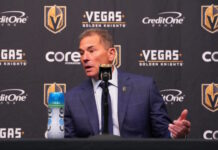


When asked why he chose to return to college football mere months after being fired at Florida, first-year James Madison coach Billy Napier asks a question in response: “How many coaches the last 10 years have gotten let go and got a chance to be a head coach the same cycle?”
The answer is just eight.
Napier posted a 22-23 record at Florida in four seasons. He had half of October and all of November to consider his coaching future. Time off was an option. His firing triggered a $21 million buyout.
But in a cycle in which almost every major Group of Six job opened, Napier couldn’t ignore interest from the reigning Sun Belt champions and a College Football Playoff participant.
“I think it’s pretty humbling to get a call,” Napier said.
A month and a half also proved enough time for Napier to realize he missed the grind.
He found out what it was like to wake up with nothing to do: A lack of goals. A lack of a team to work with every day. It made Napier want back in. He traveled. He made stops at schools like Georgia and North Texas. He called friends in the space and peppered Group of Six coaches with questions.
“I’m nowhere close to being done,” Napier told CBS Sports. “I love every single part of the job. I just love the leadership challenge. I love building a culture. I love impacting people. I love the strategy. I love to evaluate and build teams and rosters. I love to recruit. I love being part of a team.
“JMU, I can’t help but think that was a godsend to some degree.”
Life after the buyout: What fired coaches from the 2025 carousel are doing now
Brad Crawford
Reflection and regret at Florida
A month and a half is plenty of time for reflection and self-blame.
Napier said the hardest part of his firing was seeing all the people who lost their jobs because of him.
“It’s your responsibility, and you failed,” Napier said. “You came up short.”
There is some rationalizing to be made, even with a 22-23 record at a place like Florida.
Florida evaluated and developed exceptionally well during Napier’s tenure.
The Gators had seven players selected in the 2026 NFL Draft — the 10th most of any school — and had three other former signees drafted elsewhere.
“The roster we had in Year 4, which is the most frustrating part, I would have stacked it against anyone in the country,” said former Florida general manager and current James Madison Associate AD for Personnel Jacob LaFrance.
That talent upswing just came too late.
LaFrance, when thinking about the Florida tenure, believes Napier and his staff had to build faster. They had great success at Louisiana in the Sun Belt, building a roster slowly by recruiting high school players. When they moved to Florida, the sport entered a new era of the portal and name, image and likeness.
They eventually built the roster they had hoped to upon arrival. It just didn’t happen quickly enough.
“In today’s climate, you don’t have four years to put together a really good team,” LaFrance said.
When Napier thinks about what he could have changed in Gainesville, he returns again and again to delegation. It’s one thing to do everything with Louisiana. It’s another to build one of the biggest staffs in college football at Florida and still try to have a hand in every aspect.
Napier loves to evaluate. He believes his play-calling is one of his strengths. But there wasn’t enough time to do everything well. Napier called plays in his final season in Gainesville, but the offense only once cleared the 25-point barrier in six games against FBS competition.
He was openly questioned for not delegating on offense. In the end, he believes it cost him.
“Offensively is probably the biggest area, having a coordinator play caller,” Napier said. “Empowering Jacob a little bit more. …
“I needed to delegate more and empower more, and then I think that that dilutes your strengths. You’re not able to bring the same level of detail to certain areas. And that catches up with you.”
Getty Images
A gutted roster and a hotel command center
It wasn’t that long ago that Napier helped Louisiana become the dominant team in the Sun Belt. The Ragin Cajuns went 33-5 between 2019 and 2021, winning a pair of conference championships.
But 2021 is a lifetime ago in college athletics.
The transfer portal was a novelty as players were limited to one transfer in their careers. NIL didn’t exist. Sun Belt teams could live on development and have roster stability over time.
By the time Napier got to James Madison, his biggest question was how many of his players would even stick around.
Not many.
The old James Madison staff, after a brief adjustment period, helped Napier and his staff navigate the situation. They were planning to take a lot of players with them to UCLA — 13 made the Harrisburg-to-Los Angeles move — and ultimately 19 Dukes players transferred up to the Power Four level.
Forty-nine players stuck around, but only three starters return.
That’s a roster-constructing challenge Napier and his staff took on at Hotel Madison.
Bob Chessney and his staff were still using the team facilities through the first round of the College Football Playoff, which meant Hotel Madison became the operating heart of the 2026 James Madison Dukes.
A conference room served as the main office. Meeting rooms were used for interviews. The days went from 6 a.m. to midnight as a still-incomplete JMU staff grinded through portal film.
Napier and LaFrance, one of his first hires, had many conversations with the old James Madison staff and friends around the G6 about how to build a 2026 roster. There was a common theme in their answers: production from the lower levels translates.
The Dukes signed 41 transfers. Only seven of them came from the Power Four.
“We leaned on a lot of people that had done it at a high level, and that’s what they would say,” LaFrance said. “The guys that have production — D-III, D-II, FCS — it translates. They’re older. They have experience. They played a bunch of snaps.”
That strategy only works if players choose JMU, and it helps that players usually commit when they show up on campus.
James Madison, situated among the trees of the Shenandoah Valley, is a top 100 public school in the country. The Dukes get all four seasons on campus — Napier suggested it may be six — and the city’s nickname is “The Friendly City.”
All of that translated into a near 70% hit rate for commitments from official visitors between the winter and summer visit periods.
“There’s something to be said about JMU in the footprint the reputation it has,” LaFrance said. “To be honest, it recruits itself a little bit.”
These Group of Six QBs are poised to crash the College Football Playoff party in 2026
Chip Patterson

JMU culture and history provide the blueprint
Napier likes to say that success leaves behind clues.
If that’s the case, there’s plenty to be found in Harrisonburg. Bob Chesney led JMU to the CFP. Curt Cignetti went 52-9 with the Dukes, helping them make the jump from the FCS to the FBS. Mike Houston led JMU to an FCS national title.
When Napier observed James Madison in December, he saw plenty of talent. He also observed a player-led culture and something that felt singular to the Dukes.
“We get a smart guy and a guy who loves ball and wants to win,” Napier said of the type of players who end up at James Madison. “Every single kid is the underdog. They’re right in that sweet spot with a chip on their shoulder, something to prove. They’re highly motivated.”
Napier is, too.
Given a second shot to build a Sun Belt winner — one built atop decades of success and an administration that’s all-in on football — Napier hopes to learn from his shortcomings and once again build an annual contender in the Sun Belt.
It’s why he hired a play-calling offensive coordinator at James Madison. It’s why the Dukes came out swinging in the portal to begin his tenure.
“I’ve tried to take that experience and use it,” Napier said.