


No preseason top 25 team enters the college football season without a flaw hidden beneath championship expectations. For every roster loaded with future NFL talent, there is an unproven quarterback, rebuilt position group or unforgiving schedule capable of wrecking the plan.
Optimism sells in August, but concern often determines which contenders survive November. This exercise examines both sides of every ranked program, separating the legitimate national title threats from teams carrying more preseason hype than staying power.
Some have elite quarterbacks and questionable defenses. Others own championship lines of scrimmage but lack proven playmakers. The margin for error has never felt thinner in the 12-team College Football Playoff era.
College football rankings: Ohio State tops Oregon as SEC teams shoot up in Preseason CBS Sports 138
Chip Patterson
Here is the best reason to believe in every top-25 team — based on their spots within our preseason CBS Sports 138 rankings — and the biggest issue that could send its season sideways before December.

1. Ohio State
Concern: Replacing early-round picks
The Buckeyes reload better than nearly every program, but replacing a handful of defensive starters who were taken on Day 1 or in the second round of April’s NFL Draft is a different challenge entirely. Arvell Reese, Sonny Styles and Caleb Downs were more than recognizable names; they were tone-setters, difference-makers and the heartbeat of one of college football’s most dominant units.
The next wave is talented, and Ryan Day’s recruiting machine — especially through the portal — ensures few obvious holes. Still, expecting identical production feels unrealistic. Elite defenses require chemistry, experience and stars delivering in critical moments. Even for Ohio State, replacing that combination immediately may prove impossible. A brief step backward should surprise no one, particularly early this season.
Optimism: Elite QB, WR rooms
Julian Sayin and Jeremiah Smith could form college football’s most unstoppable quarterback-receiver combination, given their shared precision and game-breaking ability. Sayin enters with total command of Ohio State’s offense, while Smith remains the sport’s ultimate matchup nightmare — too physical for cornerbacks and too explosive for safeties. Defenses can roll coverage his direction, but that only creates easier opportunities elsewhere. When protection holds, few answers exist.
Sayin’s accuracy, paired with Smith’s catch radius and acceleration, gives the Buckeyes a connection capable of wrecking any game plan in America and potentially getting two players to New York as Heisman finalists.
2. Oregon
Concern: First-year coordinators
Dan Lanning enters unfamiliar territory at Oregon after losing each of his top assistants during the same offseason for the first time in his head coaching career. Replacing one trusted playcaller is difficult enough. Rebuilding the leadership structure on both sides of the football creates an entirely new challenge for a program carrying national championship expectations.
Oregon recruited at an extremely high level, and Oregon’s roster remains loaded, but continuity matters when November arrives, and every adjustment is magnified. The Ducks possess enough talent to reach the CFP again, though the transition could create early turbulence as new voices establish their identity and rhythm.
Optimism: Most talented defense in program history
Few teams possess a deeper defensive roster than the Ducks, starting with a front built to overwhelm opponents with veterans. Oregon possesses length, power and multiple future NFL players along the defensive line, while their linebacker room provides the speed necessary to erase mistakes and attack downhill.
The secondary might be even better, featuring enough athleticism and versatility to survive against elite passing attacks. Lanning’s recruiting success is obvious here. Oregon can rotate bodies, stay fresh and dictate matchups without sacrificing production — exactly what championship defenses require today.
3. Notre Dame
Concern: Two first-time starters at OT
Notre Dame’s offensive line should be the backbone of a playoff run, especially with CJ Carr taking on greater responsibility and a retooled backfield finding its footing. However, there’s still a decent amount of concern before taking the field against Wisconsin, since right tackle Guerby Lambert is moving over from guard, and Will Black at left tackle is a redshirt freshman.
Neither player has started a game at either position. Given the investment in Carr, offensive tackle is the second-most important position on the field, and it’s paramount that these choices from the coaching staff get the job done. Elsewhere, the Fighting Irish return the size, experience and physicality necessary to control games at the point of attack.
Optimism: Schedule conducive to success
Two early losses last season prevented the Fighting Irish from getting to the CFP, and in 2026, Notre Dame could be facing the same predicament if it loses two of three contests against BYU, Miami and SMU — three teams ranked this preseason. The SOS will not be powerful enough to warrant praise at 10-2 overall from a selection committee that has already shown us how much overall record and quality victories matter. However, Notre Dame will be a betting favorite in every contest, and most assume it will be a top-4 seed with an opening-round bye.
Is a Notre Dame CFP berth inevitable? Here are 5 teams capable of derailing the Irish’s postseason plans
Brad Crawford

4. Texas
Concern: Navigating nation’s toughest schedule
In a national championship-or-bust season for the Longhorns, Steve Sarkisian’s team drew the short end of the stick with this slate. The Longhorns host Ohio State in Week 2, battle top-15s Oklahoma and Ole Miss and travel to Tennessee, LSU and Texas A&M during SEC play. That’s a playoff résumé if Texas survives, but it’s also a path toward three losses before conference championship weekend. That fate kept the Longhorns out of the CFP last fall. Talent won’t be the issue in Austin. Week-to-week recovery, quarterback consistency and winning close games will determine everything. Texas might be one of the nation’s best teams and still find itself outside the 12-team bracket.
Optimism: Portal acquisitions look the part
By now, you’ve seen the viral practice reel of Cam Coleman‘s leaping one-handed catch on a ball placed behind this cycle’s top-ranked wideout. Coleman is arguably the most talented pass catcher that Sarkisian has had to work with offensively since he coached DeVonta Smith to a Heisman in 2020 as Alabama‘s OC, and the best-case scenario is that production is replicated on the Forty Acres. Raleek Brown, Hollywood Smothers and other newcomers offensively should provide Texas with a significant boost.
5. Georgia
Concern: Minimal proven production at WR
Georgia‘s wide receiver room carries more uncertainty than usual after Zachariah Branch’s departure for the NFL. Branch gave the Bulldogs a proven separator and explosive option capable of changing games in space, and replacing that production won’t be automatic. Kirby Smart has recruited enough talent to prevent a full-blown crisis, but potential and dependable Saturdays are different things.
Georgia needs a new go-to target to emerge, especially against SEC defenses determined to crowd the box with Nate Frazier in the backfield. If that answer never arrives, the passing game could lack the vertical threat — at wideout, since the tight end room is stout — necessary to maximize the offense’s championship ceiling in big games. Georgia Tech transfer Isiah Canion leads all options on the outside with 39 career catches for 563 yards and four touchdowns over two seasons. Fellow starters Sacovie White-Helton and London Humphreys have 67 career receptions combined.
Optimism: Loaded back seven on defense
It’ll be difficult to find a better collection of linebacker and secondary talent across the SEC in totality when looking at Georgia’s two-deep. Raylen Wilson and Chris Cole should have monster seasons in the middle, while Ellis Robinson and K.J. Bolden could be first-round selections next spring. The additions of Ja’Marley Riddle, Khalil Barnes and Gentry Williams in the portal solidify spots of need at strong safety and nickel. Georgia has ranked in the top 10 nationally in pass defense only once over the last six seasons (2023), but it has a unit capable of doing so this fall.
6. Indiana
Concern: Replacing valuable leadership
There’s a reason Curt Cignetti decided to skip over the choosing of captains this early during preseason camp — he’ll let the team figure it out once difference-makers emerge and progress by example. Not only were Fernando Mendoza, D’Angelo Ponds and Aiden Fisher extremely productive on the field last season for the national champions, but they also vocalized maturity within the locker room, and the Hoosiers must identify who those guys are going to be this season in the coming weeks.
Optimism: Significant transfer portal wins
The Hoosiers appear to have done it again, turning the transfer portal into another roster-building cheat code. Indiana attacked specific needs, added proven production and found players who fit the program’s demanding personality rather than chasing recruiting headlines. Well, the Hoosiers actually accomplish a little bit of both after signing quarterback Josh Hoover (TCU), wideout Nick Marsh (Michigan State) and others. That formula has fueled Indiana’s rapid rise, and this latest haul looks capable of delivering immediate impact across the depth chart.
Cignetti knows exactly what translates to his system and rarely wastes evaluations. Winning the portal is not simply about collecting stars; it is about building a functional team. Indiana keeps swinging big and connecting with authority each offseason.
Getty Images
7. Miami
Concern: Third-down dominance on defense
Inside the program, there’s no worry here after the Hurricanes signed former Missouri edge rusher Damon Wilson II and welcomed back Marquise Lightfoot in an extended role. However, two All-ACC performers — Rueben Bain Jr. and Akheem Mesidor, who led the Power Four in pass-rush snaps — aren’t easily replaceable, no matter what the personnel looks like. Ahmad Moten’s presence at defensive tackle will go a long way in determining how potent this defensive front will be with a couple of new starters.
Optimism: Offense could be record-setting
Miami has the personnel to field college football’s most explosive offense, beginning with Darian Mensah, who can stretch defenses vertically. Pairing Mensah with Malachi Toney gives the Hurricanes a game-breaking connection capable of flipping the field on any snap, while Mark Fletcher Jr. supplies the power and consistency needed to punish lighter boxes. There’s talent behind him, too.
Defenses can’t devote extra attention to Toney without creating favorable rushing looks, and crowding the line invites Mensah to take shots downfield for others like Duke transfer Cooper Barkate and former South Carolina field-stretcher Vandrevius Jacobs. Mario Cristobal’s roster has balance, star power and proven production at the most important positions. If the offensive line holds, Miami should score in bunches against everyone it plays this fall.
8. Texas Tech
Concern: QB depth behind Will Hammond
Texas Tech‘s championship ceiling may hinge on Hammond staying healthy after Brendan Sorsby’s unexpected offseason departure created an obvious concern beyond the expected starter. Hammond has the talent, familiarity and playmaking ability to steer one of the Big 12’s most explosive offenses, but the Red Raiders are operating without much proven insurance if plans change or his knee isn’t 100%. That’s dangerous territory for a program carrying legitimate CFP expectations. Joey McGuire and his staff have upgraded nearly every corner of this roster, yet quarterback depth remains the glaring exception. One awkward hit could force Texas Tech to lean on an untested option in a pressure-packed season.
Optimism: Rushing attack is Big 12’s best
The Red Raiders’ deepest position may be its most dependable with Quinten Joyner, Cameron Dickey and J’Koby Williams returning to form one of the Big 12’s best backfields. Texas Tech welcomes Joyner back after he missed the 2025 campaign with a torn ACL, which gave way to Dickey and Williams showing out. This rotation should help preserve everyone for the season’s defining stretch. With uncertainty at quarterback beyond Hammond, leaning on this group makes sense. Texas Tech spent lavishly to construct a contender, yet its greatest offensive luxury was already on the roster.
9. Oklahoma
Concern: Five top-10 opponents on schedule
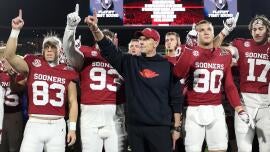
The offense was not as efficient as it needed to be last season, but the Sooners still found a spot in the CFP. To get back, not only will quarterback John Mateer have to stay healthy, but navigating one of the SEC’s toughest slates is the bigger obstacle. In addition to playing Michigan on the road in non-conference play, Oklahoma travels to preseason conference frontrunner Georgia and to The Swamp for Florida, takes on Texas in Dallas and hosts Ole Miss and Texas A&M. That’s a brutal stretch for a team with high expectations.
Optimism: More playmakers on offense via portal
In addition to signing three tight ends in the transfer portal, the Sooners expect to start portal stars Parker Livingstone (Texas) and Trell Harris (Virginia) at wide receiver, and Colorado State‘s Lloyd Avant offers a change-of-pace option in the backfield after starting Oklahoma’s spring game. He appears to have already earned the coaching staff’s trust and may get first-team carries this season.
A united front: Brent Venables, Oklahoma’s new AD face the SEC’s hardest questions together
Brandon Marcello
10. LSU
Concern: Two-deep loaded with newcomers
Signing the nation’s No. 1 transfer class aids in all transitions, but collecting talent and building a connected football team are two different assignments. The Tigers added proven playmakers from across the country, many accustomed to different systems, standards and locker-room dynamics. Kiffin must establish roles, chemistry and trust before LSU’s championship-level schedule exposes any cracks. There is no portal shortcut for cohesion. If this group meshes quickly, LSU can contend immediately. If not, early growing pains could become costly in the SEC race all season.
Optimism: Strength in the trenches
Pushing around the opposition should not concern the Tigers, whose biggest advantage could surface where championship teams are built — along the line of scrimmage. Kiffin’s staff paired a powerful freshman class along the defensive line with an absurd portal haul, giving the Tigers immediate size, depth and competition across both fronts. The newcomers may need time to develop chemistry, but the physical traits are undeniable.
Former Colorado offensive tackle Jordan Seaton leads the charge, along with Ole Miss transfer Princewill Umanmienlen. LSU now has enough bodies to rotate without sacrificing much and create favorable matchups late in games. The Tigers should control the trenches against most opponents.
11. Texas A&M
Concern: Four new starters on offensive line
Center Mark Nabou Jr. is this team’s lone returning starter in the trenches offensively after left tackle Trey Zuhn, left guard Chase Bisontis, right guard Ar’maj Reed-Adams and right tackle Dametrious Crownover were all selected in the 2026 NFL Draft. Mike Elko ensured his team signed quality veteran starters to fill those roles, but it may take time for them to gel. Each of Texas A&M’s newcomers started games elsewhere in the SEC, including guard Trovon Baugh at South Carolina and Coen Echoles at LSU.
Optimism: Wideout room could be spectacular
Despite losing KC Concepcion to the NFL, Texas A&M welcomes back Mario Craver, Terry Bussey, Ashton Bethel-Roman and signed Alabama’s Isaiah Horton from the portal to solidify a band of field-stretchers for quarterback Marcel Reed. Bussey has turned heads in the first couple of practices of fall camp, and Craver is coming off a 59-catch, 917-yard season despite being bothered by an injury. Craver’s 207-yard explosion during Texas A&M’s win at Notre Dame last fall was his coming-out party nationally.
12. Ole Miss
Concern: Seven transfer starters on defense
Pete Golding’s not going to lose too much sleep with Will Echols and Suntarine Perkins manning the defensive front, but watching two of his best players sign with Kiffin and LSU stings a bit. Luke Ferrelli (California) and Keaton Thomas (Baylor) should stabilize the linebacker position; however, the secondary is virtually all-new, and defending the pass was a team strength during last fall’s CFP run.
There’s been hesitancy from Golding this summer in praising this year’s team before they play Louisville in Nashville to open the campaign. New faces on his side of the football are part of the reason.
Optimism: Best 1-2 punch at QB, RB in SEC
The Rebels expect offensive fireworks with Trinidad Chambliss and Kewan Lacy returning to the lineup, retention wins this offseason, which did not come cheap. Their familiarity, experience and big-play ability should give Ole Miss immediate confidence in an attack built to stress defenses from sideline to sideline under play-caller John David Baker, who’s back in Oxford after a couple of years at East Carolina.
Chambliss provides the trigger and improvisational ability necessary to extend drives, while Lacy gives Ole Miss a proven playmaker capable of turning routine opportunities into explosive gains. The supporting cast has changed, but the ceiling remains obvious. If both stay healthy, the Rebels should remain one of the SEC’s most dangerous offensive teams.
Getty Images
The rest of the top 25 …
| 13. Alabama | Just two starters back on offense | SEC’s best defensive backs |
| 14. USC | Replacing elite production at WR | Lincoln Riley’s most talented USC roster |
| 15. Michigan | Bryce Underwood‘s supporting cast | Physicality-first mindset returns |
|
16. BYU |
Thirteen returning starters |
Reliable targets must emerge at WR |
|
17. Tennessee |
Inexperience at QB |
One of SEC’s deepest WR, RB rooms |
|
18. Penn State |
Familiarity with first-year roster |
Miss Ohio State, Oregon and Indiana in Big Ten |
|
19. Washington |
Lacking depth at skill positions |
Talented backfield led by Demond Williams Jr. at QB |
|
20. SMU |
Seven new starters defensively |
Three-year starter Kevin Jennings returns at QB |
|
21. Iowa |
Replacing 7 of top 8 DL |
Kamari Moulton anchors physical backfield |
|
22. Florida |
No decision on starting QB yet |
Jon Sumrall inherits complete roster elsewhere |
|
23. Missouri |
Replacing most of the starting defense |
Ahmad Hardy, Jamal Roberts are 2k-yard capable |
|
24. Utah |
Replacing heart of pass rush |
Dynamic ability at QB: Devon Dampier, Byrd Ficklin |
|
25. Louisville |
Thirteen new transfer starters |
RB Isaac Brown is one of ACC’s top playmakers |