

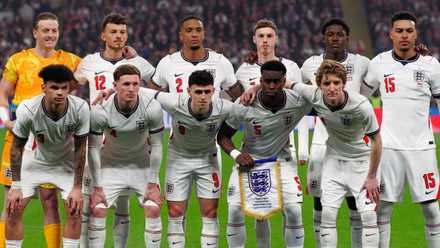
England were held to a goalless draw by Ghana in one of the most closely watched matches of the World Cup group stage.
The result left Thomas Tuchel‘s side with work still to do in their battle to secure top spot in the group, and came as a timely reminder that the Three Lions aren’t quite the finished article yet after a rampant opener against Croatia.
England created chances but were unable to find a breakthrough against a disciplined Ghana side, with Harry Kane and Nico O’Reilly coming closest near full-time.
Ghana, meanwhile, defended resolutely and produced several dangerous counter-attacks of their own.
You scored
out of 20
England now prepare to face off against Group L minnows Panama, whom they beat 6-1 at the Russia World Cup in 2018 under Sir Gareth Southgate – the first and last time they battled the Central Americans.
Tuchel’s side are still in a very strong position to confirm their place in the knockout rounds, and must equal or better Ghana’s result against Croatia to seal top spot and play a third-placed side in the Round of 32.
Arsenal will bid for “underrated” £120k-per-week England star who wants to join them
The Gunners are poised to open formal talks.
If that were to happen, England could well find themselves locked in a fierce derby battle against Scotland, with Steve Clarke’s men likely to finish as one of the best third-placed teams provided they don’t get thrashed by Brazil.

While fans are inevitably weighing up England’s most likely passage in the knockouts, much of the discussion after the final whistle centred on Jude Bellingham and an incident involving the Real Madrid midfielder.
During the second half, television cameras captured Bellingham speaking with Ghana forward Jordan Ayew.
As the pair exchanged words, Bellingham briefly covered his mouth with his hand.

The moment immediately attracted attention because of FIFA’s new regulations introduced for the 2026 World Cup.
Earlier in the tournament, Paraguay midfielder Miguel Almiron became the first player to be sent off under those rules.
Almiron received a red card during Paraguay’s match against Turkey after covering his mouth while speaking to an opponent during an on-field confrontation.
The dismissal came after a VAR review.

Referee Ivan Barton was advised to examine the incident before deciding to issue a straight red card.
The new FIFA rule was introduced ahead of the tournament and specifically targets situations where players conceal their mouths during confrontations with opponents.
The measure forms part of FIFA’s wider effort to improve transparency during disputes on the pitch and tackle offensive or abusive language.
Because of Almiron’s dismissal, many supporters immediately questioned why Bellingham was not punished for the same thing against Ghana.

Social media quickly filled with comparisons between the two incidents, and wuestions were also raised by television pundits and commentators following the match.
The explanation appears to centre on the context of the exchange.
How Jude Bellingham luckily escaped red card against Ghana
According to reports following the game, FIFA’s guidance differentiates between confrontational incidents and ordinary conversations between players.

Bellingham’s discussion with Ayew was not deemed aggressive or confrontational by the match officials, because there was no dispute taking place between the two players.
Neither player reacted angrily during the exchange.
That contrasted sharply with Almiron’s dismissal.
In Paraguay’s match against Turkey, the exchange occurred during a disagreement between opposing players following a foul.
The confrontation was visible to officials and ultimately resulted in disciplinary action.
Almiron later received a one-match suspension after the red card.

The difference between the two situations has now become a major talking point around FIFA’s new rule.
The law is still relatively new and this is the first major tournament in which it has been applied.
Several players have already altered their behaviour during matches as awareness of the regulation spreads, and Bellingham’s incident highlighted how much interpretation remains involved in applying the rule.
The act of covering the mouth itself is not automatically punishable.
Instead, officials must determine whether it takes place during a confrontation or aggressive exchange with an opponent.
That distinction proved crucial in England’s draw with Ghana, and it was why Bellingham didn’t receive his marching orders in what would’ve been a massive blow for Tuchel.

Aston Villa eyeing “elite” £69m World Cup talent with opening bid already rejected
The Villans are contending with Man United.